
Portland South Metro · ISA Certified · LCB# 100543
Tree Cabling and Bracing Service in Portland, OR
Tree cabling and bracing service is one of the most misunderstood — and most frequently oversold — services in the tree care industry. At Grove Tree Care, we only recommend cabling or bracing when it genuinely extends the life of your tree and reduces real risk. Our ISA-certified arborists assess every tree honestly and tell you when support systems make sense — and when they don’t.
- ISA Certified Arborists on Every Assessment
- Oregon LCB License #100543
- Honest Recommendations — No Upsells
- ANSI A300 Installation Standards
- Free Estimates — No Obligation
What Is Tree Cabling and Bracing Service — and When Do You Need It?
Our tree cabling and bracing service involves installing flexible steel or synthetic cables between major limbs or stems to redistribute stress and reduce the risk of failure. Tree bracing uses threaded steel rods inserted through weakened branch unions or crotches to provide rigid reinforcement of split or cracked wood. Together, cabling and bracing form a structural support system for trees that have specific vulnerabilities — but are otherwise worth preserving.
The key word is “worth preserving.” Cabling and bracing are tools for trees that have significant value — ecological, aesthetic, historical, or financial — and a specific, addressable structural problem. They are not a solution for trees in general decline, severe disease, or root failure. A tree that needs to come down should come down. Our ISA-certified arborists will tell you which situation you’re in — honestly — before recommending any work.
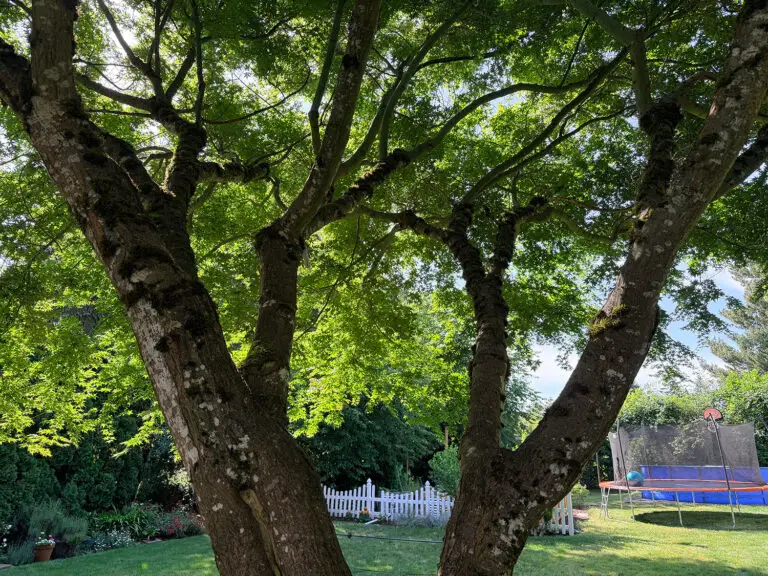
When Tree Cabling & Bracing Makes Sense — and When It Doesn't
This is the question most tree companies won’t answer directly. Here’s our honest framework, based on ISA standards and ANSI A300 Part 3 guidelines — the same standards our arborists follow on every assessment.
Cabling or Bracing Is Usually the Right Call When:
- Two co-dominant stems (V-shaped crotch) create a high failure risk on a tree with significant value
- A major limb is overextended and at risk of failure but the rest of the tree is healthy
- A historically significant or heritage tree has a structural vulnerability that can be addressed
- A branch hangs over a structure, vehicle, or play area and removal would significantly harm the tree
- A tree has a partially split union that can be stabilized before it progresses to full failure
- A mature tree sustained wind damage but remains structurally sound overall
We'll Recommend Removal or Pruning Instead When:
- The tree is in general decline with multiple failing systems
- Root rot or vascular disease has compromised the tree's ability to hold cables safely
- The structural defect is too large or widespread to be meaningfully addressed by cabling
- The tree's overall condition means cabling would only delay an inevitable failure
- The cost of cabling exceeds the value of preserving the tree
An honest arborist tells you this upfront. We do. Read our guide on signs your tree is dying or hazardous to understand what our arborists look for before recommending any structural support.
Types of Tree Cabling and Bracing Systems We Install
Different structural problems require different solutions. Here’s what our ISA-certified arborists use and when each system is appropriate for Portland south metro trees.
High-Strength Steel Cabling
The traditional standard for tree support. High-strength steel cables are installed between major limbs or stems using eye bolts, providing flexible but strong support that limits movement without restricting natural sway. Appropriate for co-dominant stems and overextended limbs on mature conifers and hardwoods — the most common candidates in West Linn, Lake Oswego, and Wilsonville.
Synthetic (Low-Stretch) Cabling
Cobra or similar synthetic systems use a flexible, low-stretch rope that allows more natural movement while still limiting dangerous swing. Lower visual impact than steel, easier to install without drilling, and appropriate for trees where preserving aesthetics matters — common in lakefront properties and high-visibility landscapes.
Steel Rod Bracing
Threaded steel rods installed through weak branch unions or crotches to provide rigid reinforcement of split or cracked wood. Used when a union is partially split and the split can be physically closed and stabilized. Rod bracing is often combined with cabling for comprehensive structural support.
Dynamic Support Systems
For trees where some movement is beneficial to long-term strength — particularly younger trees — dynamic support systems allow controlled movement while preventing dangerous overextension. Less common but appropriate for specific situations our arborists will identify on assessment.
Multi-Point Cabling
Large mature trees with complex canopy structures sometimes require multi-point cabling systems — multiple cables connecting several major limbs. Common for Oregon white oaks, heritage Douglas firs, and large big-leaf maples that are structurally significant but have developed asymmetric canopies.
Our Tree Cabling & Bracing Assessment Process
Here’s exactly what our tree cabling and bracing service process looks like…
Step 1 — Free On-Site Assessment An ISA-certified arborist visits your property and evaluates the tree — structure, root system, canopy condition, and the specific defect you’re concerned about. We assess whether cabling or bracing is genuinely appropriate, or whether another approach makes more sense. No charge, no pressure.
Step 2 — Honest Recommendation We tell you what we found and what we recommend — including whether we believe cabling is worth doing or whether removal or pruning is the better option. We explain our reasoning in plain language and answer every question you have.
Step 3 — Written Estimate If cabling or bracing is appropriate, you receive a clear written estimate specifying the system type, hardware, installation method, and total cost. No verbal quotes. No surprises.
Step 4 — Installation Our crew installs the cabling or bracing system following ANSI A300 Part 3 standards. Hardware is installed at the correct height, cables are tensioned properly, and any drilling is done to minimize damage to the tree’s vascular system.
Step 5 — Inspection Schedule Cabling and bracing systems require periodic inspection — typically every 1-2 years — to ensure hardware hasn’t been outgrown by the tree and tension remains appropriate. We’ll schedule your first follow-up inspection and remind you when it’s due.
Why Choose Grove Tree Care for Tree Cabling & Bracing
Tree cabling is one of the services most commonly oversold in the tree industry. Here’s how we do it differently.
We Only Cable When It Actually
Helps We turn down cabling jobs when cabling isn’t the right answer. If a tree needs to come down, we’ll tell you. If pruning solves the problem, we’ll say so. Our ISA-certified arborists give honest assessments — not assessments designed to maximize the invoice.
ISA-Certified Arborists
Assess Every Job Cabling and bracing requires genuine expertise in tree physiology and structural mechanics. Our certified arborists bring both — and they’re on every assessment, not just the estimate call.
ANSI A300 Installation
Standards Every cabling and bracing system we install follows ANSI A300 Part 3 standards — the arboriculture industry’s benchmark for structural support systems. This matters for both the effectiveness of the installation and your liability protection.
South Metro Local Knowledge
West Linn’s hillside Douglas firs. Wilsonville’s heritage trees. Lake Oswego’s mature oaks. Tualatin’s ornamental specimens. Each species and each terrain presents different cabling challenges. We’ve assessed and installed across all of them.
Transparent Pricing
$150 per crew member per hour, 4-man crew minimum. Written estimate before any work begins. No surprise add-ons.
Tree Cabling & Bracing Service Across the Portland South Metro
Looking for tree bracing near me in the Portland south metro? Grove Tree Care provides free on-site assessments across West Linn, Tualatin, Wilsonville, Lake Oswego, Oregon City, and Sherwood.
Tree Cabling & Bracing — Frequently Asked Questions
A: The most common candidates are trees with co-dominant stems (two stems of roughly equal size forming a V-shape), overextended limbs hanging over structures, or partially split branch unions. However, the only reliable way to know is an ISA-certified arborist assessment — the signs are specific and require expertise to evaluate correctly. We offer free on-site assessments across the Portland south metro. Read our guide on signs your tree is dying or hazardous for a broader look at warning signs.
A: When installed correctly following ANSI A300 Part 3 standards, cabling and bracing do not significantly harm a healthy tree. Eye bolts require drilling, which creates a wound — but a properly sized hole in a healthy tree heals over time. The risk comes from improper installation: wrong hardware, incorrect tension, or installing at the wrong position on the tree. This is why ISA certification matters on cabling jobs.
A: Steel cabling systems typically last 10-15 years before hardware needs replacement, though they require inspection every 1-2 years to ensure they haven’t been outgrown by the expanding trunk. Synthetic systems have varying lifespans depending on UV exposure and system type. We’ll advise you on the expected lifespan and inspection schedule for your specific installation.
A: Grove Tree Care charges $150 per crew member per hour with a 4-man crew minimum ($600 minimum). Most residential cabling assessments and installations run 2-4 hours depending on the system complexity. Hardware costs for cable, eye bolts, and rod bracing are included in your written estimate. For a full pricing breakdown, see our 2026 tree removal and tree care cost guide.
A: Cabling reduces the risk of limb or stem failure in trees with specific, addressable structural problems — but it is not a guarantee against failure, and it is not appropriate for all trees. A cabling system reduces dynamic loading and limits dangerous movement. It does not fix root problems, disease, or general decline. Our arborists will be honest with you about what cabling can and cannot do for your specific tree.
No — cabling and bracing are maintenance activities, not removal, and generally do not require a permit in south metro cities. However, if the assessment reveals the tree should be removed rather than cabled, permit requirements would apply. See our tree removal permit guide for the Portland south metro for city-specific permit information.
A: Oregon white oaks with wide-spreading limbs, mature Douglas firs with co-dominant stems, big-leaf maples with overextended canopies, and ornamental trees like flowering cherries and magnolias with weak branch unions are the most common candidates in our service area. Heritage trees in Wilsonville and significant trees in West Linn’s hillside neighborhoods account for a significant portion of our cabling work.
A: Cabling uses flexible cables installed between major limbs or stems to limit dangerous movement. Bracing uses rigid steel rods drilled through weak branch unions or crotches to physically reinforce cracked or split wood. They address different structural problems and are often used together for comprehensive support. Our arborists determine which system — or combination — is appropriate for your tree’s specific issue.
Is Your Tree a Candidate for Cabling or Bracing?
The only way to know for certain is an on-site assessment from an ISA-certified arborist. Grove Tree Care’s tree cabling and bracing service is available across West Linn, Tualatin, Wilsonville, Lake Oswego, Oregon City, and the entire Portland south metro. We’ll give you an honest answer — including if cabling isn’t the right solution for your tree.
Licensed · ISA Certified · LCB# 100543 · ANSI A300 Standards info@thegrovetree.com · thegrovetree.com · Aurora, OR