
Grove Tree Care · Tree Care Blog · Portland South Metro
How to Tell Normal Browning from a Real Warning Sign
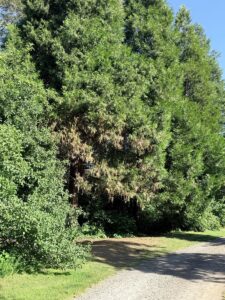
Cedar tree browning in Portland Oregon is one of the most common calls we get from south metro homeowners — and the answer to “is my cedar dying?” is almost always more nuanced than a simple yes or no. The photo below shows exactly what we’re talking about: significant browning on a Western Red Cedar with green tips still present. In some cases this is completely normal. In others it’s a warning sign that needs attention. Here’s how to tell the difference. If you’re noticing cedar tree browning in Portland Oregon this season, the pattern of where the browning appears matters more than the browning itself.
The Short Answer — Interior Browning Is Usually Normal
Western Red Cedar (Thuja plicata) naturally sheds interior foliage every year as part of a process called seasonal flagging. Old interior foliage turns brown and drops, making room for new growth at the branch tips. This happens most visibly in late summer and fall but can occur year-round in stressed conditions.
The pattern matters enormously. If the browning is concentrated in the interior of the tree with green growth at the tips and throughout the outer canopy — as in the photo above — that’s almost certainly normal flagging. If the browning is moving from the tips inward, spreading across entire branches, or appearing in patches throughout the outer canopy, that’s a different story entirely.
The rule our ISA-certified arborists use: green tips with brown interior is usually fine. Brown tips with green interior is a warning sign.
What Normal Cedar Flagging Looks Like
Normal seasonal flagging in Western Red Cedar has a few consistent characteristics that distinguish it from disease or pest damage:
The browning appears in the interior of the canopy — the older, inner foliage — while the branch tips and outer canopy remain healthy green.
The browning occurs relatively uniformly across the tree rather than in distinct patches or on one side only.
The affected foliage is dry and papery rather than discolored by spots, lesions, or resinous discharge.
The browning is most pronounced in late summer through fall, though it can occur in spring as well.
New growth at the tips appears healthy and continues to extend normally.
If your cedar matches this description, no action is required. The brown foliage will drop naturally and the tree will continue to push new growth from the tips.
Warning Signs That Deserve a Closer Look
These signs go beyond normal seasonal browning and warrant a call to an ISA-certified arborist (one that uses ANSI A300 Standards):
Browning at the tips rather than the interior Tip dieback — brown starting at the outermost growth and moving inward — is the opposite of normal flagging. It can indicate drought stress, root problems, chemical damage, or the early stages of Kabatina or Phomopsis blight, both of which affect cedars in the Pacific Northwest.
Brown patches on one side of the tree only One-sided browning often indicates a site problem — road salt damage from de-icing chemicals, reflected heat from a wall or pavement, root damage from construction or utility work on that side of the tree, or herbicide drift. It can also indicate the early stages of root rot affecting the tree’s ability to transport water uniformly.
Canopy thinning combined with browning A tree that is both browning and visibly thinner than it was a year or two ago is showing signs of cumulative stress. The combination suggests the tree is not recovering between stress events — whether drought, disease, or root damage.
Resinous discharge or pitch tubes on the trunk Small mounds of crystallized pitch on the trunk of a cedar indicate bark beetle activity. Bark beetles typically attack trees that are already stressed. Their presence alongside browning foliage is a significant warning sign that the tree’s health is declining.
Browning combined with structural changes Leaning, bark splitting, fungal growth at the base, or soil heaving near the root zone alongside foliage browning indicates a more serious problem affecting the tree’s structural integrity, not just its foliage.
Brown foliage that doesn’t drop Normal flagging produces foliage that dries, turns brown, and drops. Foliage that turns brown and stays attached — sometimes called flagging that “hangs on” — can indicate a fungal disease like Seiridium canker or Pestalotiopsis, which kill branch tissue in a way that prevents normal abscission.
Cedar Browning and Summer Heat in the Portland South Metro
Portland and the south metro have experienced increasingly intense summer heat events over the last several years. Western Red Cedar is particularly sensitive to summer drought and heat stress — more so than Douglas fir or Oregon white oak. Trees that were planted in sites with poor drainage, compacted soil, or competition from other roots often show more pronounced browning during and after hot dry summers.
If your cedar’s browning worsened noticeably after a heat event or during a drought period, deep watering is your first response. Cedars benefit from slow, deep watering that reaches the entire root zone — a soaker hose run for several hours is more effective than frequent shallow watering. Mulching around the base (keeping mulch away from the trunk itself) helps retain soil moisture through summer.
If the tree shows persistent stress symptoms despite adequate watering, a soil assessment and ISA arborist evaluation is the next step.
When to Call an ISA Arborist About Your Cedar
Most cedar browning does not require professional intervention. But call us when:
The browning is spreading progressively from one season to the next — getting worse each year rather than stable.
You see tip dieback rather than interior browning.
Browning is concentrated on one side of the tree or in distinct patches rather than distributed uniformly throughout the interior.
You notice resinous discharge, pitch tubes, or bark abnormalities on the trunk.
The tree is in a location near construction, pavement, or a road where salt or herbicide damage is possible.
The tree has significant landscape value — a large, mature Western Red Cedar that provides screening, privacy, or habitat is worth a professional evaluation before a problem becomes irreversible.
You’re not sure — and you want an honest answer rather than a guess.
Our ISA-certified arborists provide free on-site assessments across the Portland south metro. We’ll evaluate what we actually see and give you a straight answer about whether your cedar needs attention, treatment, or monitoring. Read more about what a tree health assessment involves and when you need one.
Cedar tree browning in Portland Oregon is something our ISA-certified arborists evaluate year-round, not just during summer heat.
A Note on Western Red Cedar in Portland South Metro
Western Red Cedar is one of the Pacific Northwest’s most ecologically significant and beloved tree species — and one of the most commonly planted privacy trees across the south metro. In West Linn, Wilsonville, Tualatin, and Lake Oswego, mature cedar hedgerows and specimen trees are defining features of residential properties. They’re also among the trees we most frequently assess for health concerns.
The good news is that most cedar browning we evaluate turns out to be normal seasonal flagging — nothing to worry about. The challenge is knowing which situations fall outside that category. When in doubt, a free on-site assessment from an ISA-certified arborist takes the guesswork out of it entirely.
If you’re dealing with cedar tree browning in Portland Oregon, an issue homeowners commonly notice this time of year, we’re happy to take a look.
Schedule a Free Cedar Tree Assessment
- ISA Certified Arborists on every assessment
- Oregon LCB License #100543
- Free on-site evaluations — no obligation
- Honest answer — including when no action is needed
- South metro based in Aurora, OR
We assess cedar tree browning in Portland Oregon properties across every city we serve, from West Linn to Oregon City.
Written by the team at Grove Tree Care — ISA-certified arborists serving West Linn, Tualatin, Wilsonville, Oregon City, Sherwood, Lake Oswego, Beaverton and the Portland south metro from our Aurora, OR shop.