
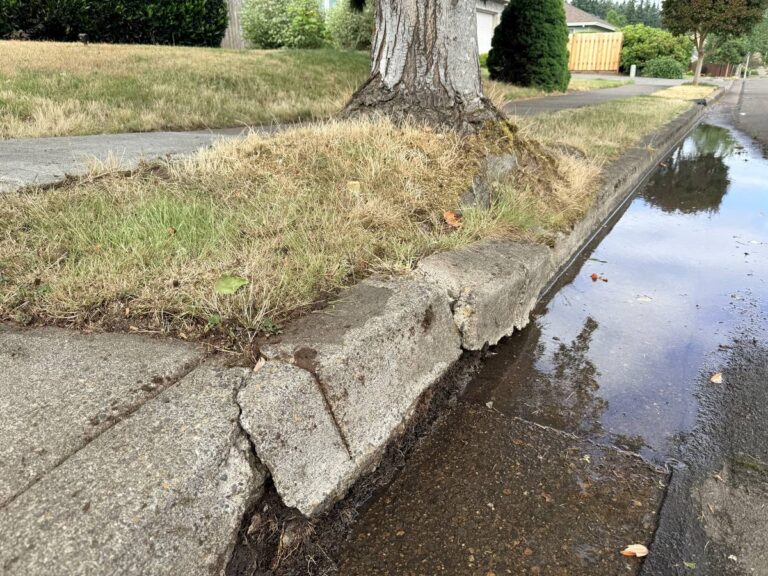
If you’ve got a buckled sidewalk slab with a tree root running underneath it, you’re not alone, and you’re probably already wondering who’s on the hook to fix it. Sidewalk damage from tree roots is one of the most common issues we see across the south metro, and the answer to who pays depends on which city you’re in. We pulled the actual municipal code and assistance programs for every city we serve so you don’t have to dig through it yourself.
The Short Answer: It's Almost Always the Property Owner
Oregon state law (ORS 368.910) sets the baseline: the owner of property next to a road is generally responsible for sidewalk and curb repair. Every city in our service area builds on that same baseline in its own municipal code. The differences between cities aren’t about whether you’re responsible, they’re about whether the city offers any financial help once you are.
Here’s how that breaks down by city.
Who’s Responsible? The property owner. (Municipal Code 5.460-5.470)
West Linn’s Municipal Code places maintenance of the right-of-way, including sidewalks and street trees, on the adjacent property owner. We’re not aware of an active reimbursement program for tree-root sidewalk damage specifically, so plan on covering the repair cost yourself unless that changes.
Who’s Responsible? Property owner (Code Ch. 2-02), but city runs an active rotating repair program
Tualatin is the most proactive city in our service area on this issue. Since 2001, the city has run a Sidewalk and Street Tree Program that evaluates one geographic zone each year on a rotating basis and repairs qualifying tree-caused sidewalk damage, often at city expense, including removing and replacing the problem tree. A recent citywide assessment found around 2,000 sidewalk defects, with 327 severe enough to qualify for the program, and the city has proposed a $1.2 million, two-year plan to work through the backlog while installing root barriers to prevent the same trees from causing repeat damage. If you’re not in this year’s repair zone and want to handle a tree issue yourself, Tualatin’s “Tree for a Fee” program lets you get a replacement street tree planted for $75.
Who’s Responsible? Property owner (Code 2.220)
Wilsonville places sidewalk responsibility on the property owner under city code, but it also runs a Residential Sidewalk Repair Reimbursement Program built specifically around the conflict between street trees and sidewalks. You’ll need three competitive bids, and the city covers up to 50% of the lowest bid, capped at $1,500 for full repair or replacement, or up to $500 for grinding and patching work.
Wilsonville’s Residential Sidewalk Repair Reimbursement Program
Who’s Responsible? Property owner (Code 12.04.030/.040)
Oregon City’s Municipal Code makes sidewalk maintenance the property owner’s job, but the city adopted a Sidewalk Replacement Assistance Grant Program in 2022 specifically for tree-root-caused damage. Funding is available up to $1,500 per tree disturbance location on a first-come, first-served basis, and the tree itself doesn’t have to be removed to qualify.
Who’s Responsible? Property Owner
Lake Oswego is direct about it: sidewalks, including damage caused by tree roots, are the property owner’s responsibility to repair. We didn’t find a dedicated financial assistance program for this specific issue in Lake Oswego, so budget for the full cost if you’re dealing with root damage here.
Who’s Responsible? Property owner (Code Ch. 12.08)
Sherwood’s Municipal Code places responsibility on the property owner, but the city’s Sidewalk Repair Assistance Program shares roughly half the qualifying repair cost, working through four geographic zones on a five-year rotation. Sherwood also requires a root barrier on every new or replaced street tree, which is a smart prevention step worth asking for even if you’re not currently dealing with damage.
Who’s Responsible? Property Owner
Beaverton confirms property owners are responsible for sidewalk maintenance, and the city does have its own Sidewalk Repair Grant Program. If you’re in an unincorporated area near Beaverton, Washington County also runs a separate Sidewalk Repair Grant Program, covering up to $2,000 (50% of the lowest of three bids), available once every 10 years per property. Check with the city directly for Beaverton’s current program terms before budgeting around a specific dollar figure.
Why Tree Roots Lift Sidewalks in the First Place
Roots don’t grow through concrete the way people often assume. What actually happens is roots spread laterally near the surface, searching for the oxygen and moisture that compacted soil under a sidewalk doesn’t have much of elsewhere. As a root thickens over the years, it pushes upward against the slab above it, and the rigid concrete cracks or lifts rather than bending. The wider and older the root, the more dramatic the lift.
Root Pruning Isn't a Permanent Fix
If a contractor offers to just cut the offending root and call it done, know that research consistently shows sidewalks lift again within about five years after root pruning alone, without some other form of root control in place. Heavy pruning can also destabilize the tree and redirect its energy in ways that make the root problem worse, not better. A real long-term fix usually means a root barrier installed alongside the repair, not just a one-time cut.
What Prevention Actually Looks Like
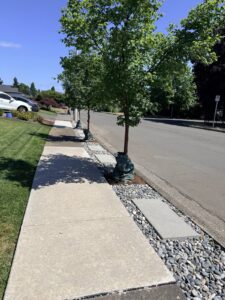
The photo below is a property where street trees were planted with a permeable gravel buffer and individual concrete pavers between the sidewalk and curb, instead of a single rigid slab. That design gives roots room to expand without lifting the walking surface, which is exactly the kind of detail that prevents this problem decades before it would otherwise start.
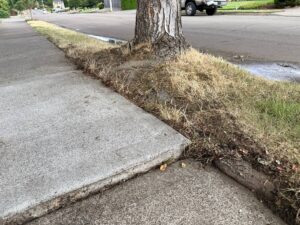
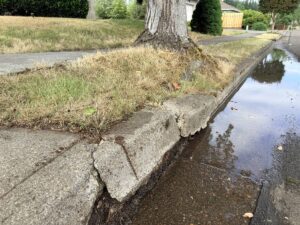
Compare that to a mature tree planted too close to the sidewalk with no protective design in place. Over time, this is what root pressure does to a curb and sidewalk panel.
If You're Already Dealing With This
If you’ve gotten a notice from your city, or you’re just noticing a sidewalk slab starting to lift near one of your trees, the first step is a proper assessment, not a guess. Our Tree Health Assessments can tell you whether root pruning, a barrier, or replanting makes the most sense for your specific tree and your specific city’s program, so you’re not paying for a repair that’s just going to need to happen again in five years.
If you’re also dealing with a tree removal permit question in the process, our city-by-city permit guide covers that side of it.