
Emerald Ash Borer Treatment in Portland, Oregon
Portland South Metro · ISA Certified · LCB# 100543 · EAB Quarantine Zone
Emerald Ash Borer Treatment in Portland Oregon
Emerald ash borer treatment in Portland Oregon is now urgent. In September 2025 the Oregon Department of Agriculture confirmed EAB in six new locations across the Portland metro — including Portland’s Hazelwood neighborhood and sites near Beaverton and Oregon City. All five counties in Grove Tree Care’s service area are now within Oregon’s official EAB quarantine zone. If you have ash trees on your property, the window to protect them with injection treatment is open right now — and it will not stay open indefinitely as infestation spreads.
- ISA Certified Arborists on Every Assessment
- Oregon LCB License #100543
- EAB Quarantine Zone Specialists
- Trunk Injection Treatment Available
- Free On-Site Assessments
- List Item
- Serving All South Metro Counties
What Is the Emerald Ash Borer and Why Does It Matter in Portland?
The emerald ash borer is a small, metallic-green beetle native to eastern Asia that arrived in the United States in Michigan in 2002. Since then it has killed hundreds of millions of ash trees across the country — earning its designation as the most destructive forest pest in North American history. It arrived in Oregon in 2022 at a school in Forest Grove, and has been spreading steadily since.
EAB kills ash trees by laying eggs on the bark. After hatching, larvae burrow under the bark and feed on the tissue that transports water and nutrients throughout the tree. This disrupts the tree’s vascular system, causing canopy dieback and eventual death. Most ash trees die within two to five years of infestation. By the time visible symptoms appear — thinning canopy, D-shaped exit holes in the bark, woodpecker activity — the infestation is often already well established.
Oregon ash is one of the state’s few native hardwoods and plays a critical ecological role in Willamette Valley riparian zones, wetlands, and urban forest canopy. Oregon white ash, green ash, and ornamental ash varieties planted as street trees throughout the south metro are all susceptible. The City of Portland has already inventoried approximately 9,700 ash street trees at risk.
Oregon's EAB Quarantine Zone — All South Metro Counties Are Affected
As of 2025, Oregon’s official EAB quarantine zone covers the entirety of five counties — all of which are within Grove Tree Care’s service area:
Clackamas County — West Linn, Oregon City, Canby, Lake Oswego Washington County — Beaverton, Tualatin, Sherwood, Forest Grove Multnomah County — Portland, East Portland, Hazelwood Marion County — Salem and surrounding areas Yamhill County — McMinnville and surrounding areas
The quarantine restricts movement of ash, olive, and white fringe tree wood, logs, nursery stock, branches, chips, mulch, stumps, and firewood out of the quarantine zone. Its purpose is to slow human-assisted spread of EAB while natural spread continues.
The quarantine does not stop EAB from spreading on its own. Beetles fly. Larvae move through connected root systems. Once EAB is established in a county, every ash tree in that county is at risk — regardless of whether your specific neighborhood has seen confirmed detections yet.
For the current quarantine map and official ODA resources, visit OregonEAB.com.
Signs Your Ash Tree May Have Emerald Ash Borer
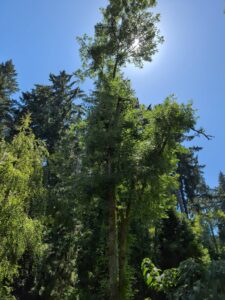
EAB is difficult to detect in early infestation because the larvae do their damage under the bark. By the time external symptoms are obvious, significant damage has already occurred. Here is what to look for:
Early Warning Signs (Act Immediately)
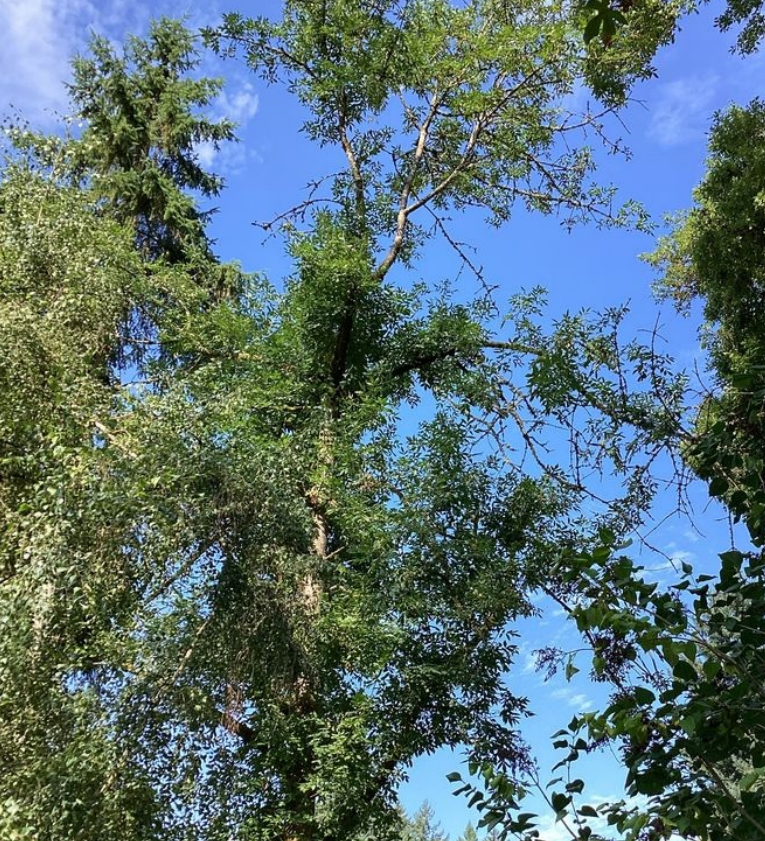
- Thinning or sparse canopy — fewer leaves than previous years, or leaves that appear smaller or discolored
- Canopy dieback starting at the top or outer branches and working inward Increased woodpecker activity on the trunk — woodpeckers feed on EAB larvae under the bark
- S-shaped galleries visible under any bark that has been removed or fallen off
- Epicormic sprouting — new shoots emerging from the lower trunk or roots, a stress response
Definitive Identification Signs
- D-shaped exit holes in the bark approximately 1/8 inch wide — the signature of EAB emergence
- Splitting or cracking bark revealing S-shaped larval galleries beneath
- Adult beetles — metallic emerald green, approximately 1/2 inch long, active May through August
Important: If you observe D-shaped exit holes, the infestation is already established and the tree may be beyond the point of treatment recovery. Contact an ISA-certified arborist immediately for an honest assessment of whether treatment can still help or whether removal is the more appropriate path.
Emerald Ash Borer Treatment Options in Portland Oregon
Properly treating ash trees with insecticides is the only way to protect them from EAB infestation, according to the Oregon Department of Forestry. Treatment works best as prevention or in early infestation stages. Two primary methods are used by licensed applicators in Oregon:
Trunk Injection — The Gold Standard
Trunk injection delivers systemic insecticide directly into the tree’s vascular system using specialized equipment. The treatment is absorbed through the tree’s own water and nutrient transport system, reaching the cambium layer where EAB larvae feed.
The most effective trunk injection treatment is emamectin benzoate — the same treatment being used by the cities of Beaverton, Hillsboro, and Portland to protect high-value public ash trees. A single trunk injection treatment provides two years of protection. Treatment can be applied spring through fall when the tree is actively transporting water and nutrients.
Trunk injection is our preferred method for most residential ash trees because it delivers the insecticide precisely where it needs to be, minimizes environmental exposure, and provides the longest protection interval.
Soil Treatment
Imidacloprid applied as a soil drench or soil injection is an alternative treatment option for ash trees. The insecticide is applied around the root zone and absorbed through the roots. Soil treatment is most effective for trees in early infestation stages with less than 40% canopy loss, applied during the spring root uptake window.
Soil treatment is generally less effective than trunk injection for advanced infestations and requires favorable soil conditions for adequate uptake.
When Treatment Is Not Recommended
Not all ash trees are good candidates for treatment. Our ISA-certified arborists will honestly assess whether treatment makes sense for your specific tree based on:
- Current canopy health — trees with greater than 50% canopy loss are generally poor treatment candidates
- Overall tree structure and condition
- Proximity to confirmed EAB detection sites
- Species — some ash varieties are more susceptible than others
- Property value of the tree vs. long-term treatment cost
We will tell you honestly when removal is the better option — including when that means a smaller job for us.
Should You Treat Your Ash Tree or Remove It?
This is the most important question, and the honest answer depends on your specific tree. OSU Extension advises against cutting down healthy ash trees unless EAB is confirmed nearby or on your tree specifically — trees can remain healthy for years before EAB finds them, and once found, take additional years to die. For healthy ash trees in quarantine zone counties, preventive treatment now is significantly less expensive than removal and replacement later.
The cost calculation is straightforward. A single trunk injection treatment for a typical residential ash tree runs significantly less than tree removal. A mature ash tree that requires removal — permit, crane work if near a structure, full cleanup — costs many times more than annual or biennial treatment. For ash trees with significant landscape value, preventive treatment is almost always the more economical path until infestation is confirmed and advanced.
The calculus changes when infestation is established. Trees with greater than 50% canopy loss, confirmed D-shaped exit holes throughout the canopy, or advanced structural decline from EAB damage are generally not good treatment candidates. In those cases, the honest recommendation is removal before the tree becomes a hazard — often requiring a permit in south metro cities.
For more on permit requirements when removing ash trees in the south metro, read our tree removal permit guide for the Portland south metro.
Our EAB Assessment and Treatment Process
Step 1 — Free On-Site Assessment An ISA-certified arborist visits your property, evaluates your ash tree’s current condition, checks for signs of EAB infestation, and gives you an honest recommendation — treatment, monitoring, or removal.
Step 2 — Treatment Plan If treatment is appropriate, we prepare a written treatment plan specifying the method, product, application timing, and projected cost. No verbal quotes.
Step 3 — Licensed Application All insecticide treatments are administered by licensed pesticide applicators following Oregon Department of Agriculture guidelines. Trunk injection is performed with specialized injection equipment that minimizes bark damage.
Step 4 — Treatment Record You receive documentation of the treatment performed — product, rate, date, and next recommended treatment window. This is important for tracking protection intervals and planning future treatments.
Step 5 — Follow-Up Schedule Trunk injection treatment with emamectin benzoate protects ash trees for two years. We’ll contact you before your next treatment window to assess the tree’s current condition and schedule re-treatment as appropriate.
Why Choose Grove Tree Care for Emerald Ash Borer Treatment in Portland Oregon
ISA-Certified Arborists Assess Every Tree
EAB treatment decisions require genuine arborist expertise — evaluating canopy health, infestation stage, and treatment viability. Our ISA-certified arborists assess every tree honestly before recommending treatment.
Honest Recommendations — Including When NOT to Treat
We tell you when removal makes more sense than treatment. If your ash tree is beyond the point where treatment can meaningfully help, we’ll say so — even though removal is a larger job.
Locally Based in Aurora — All Quarantine Zone Counties Served
Our Aurora, OR shop puts us centrally located in the EAB quarantine zone. We serve Clackamas County (West Linn, Oregon City), Washington County (Beaverton, Tualatin, Sherwood), and surrounding south metro communities where every ash tree is now at risk.
Permit Handling if Removal Is Needed
If assessment determines that removal is the right call, we handle the permit process in every south metro city — Oregon City, West Linn, Lake Oswego, Wilsonville, Tualatin, Sherwood, and Beaverton.
Emerald Ash Borer Treatment — Frequently Asked Questions
A: Yes — if your ash tree is in Clackamas, Washington, or Multnomah County, it is within Oregon’s official EAB quarantine zone. EAB has been confirmed in Portland, near Beaverton, and near Oregon City. All ash trees in the quarantine zone are at risk, though the timeline of infestation varies by location and tree condition. Contact us for a free on-site assessment to evaluate your tree’s current status. For the current quarantine map, visit OregonEAB.com.
A: Early signs include thinning canopy, increased woodpecker activity on the trunk, and S-shaped galleries under the bark. The most definitive sign is D-shaped exit holes in the bark approximately 1/8 inch wide — the signature marking left when adult beetles emerge. By the time exit holes are visible, infestation is well established. If you see any of these signs, contact an ISA-certified arborist immediately.
A: Systemic trunk injection with emamectin benzoate is considered the most effective treatment option for protecting ash trees from EAB, according to Oregon Department of Forestry guidance. The Cities of Beaverton and Hillsboro are using this exact treatment to protect hundreds of public ash trees. One treatment provides approximately two years of protection. Efficacy is highest when treatment is applied preventively or in early infestation stages.
A: Treatment cost depends on tree size, method, and the number of trees being treated. Trunk injection treatment for a typical residential ash tree runs significantly less than tree removal and replacement. We provide free written estimates before any treatment begins. Contact us for a free on-site assessment and written quote for your specific trees.
A: It depends on your tree’s current condition. OSU Extension advises against removing healthy ash trees preemptively — EAB may not reach your specific tree for years, and treatment during that window is cost-effective. For trees with significant canopy loss (greater than 50%), established infestation signs, or structural decline, removal may be the better path. Our ISA-certified arborists assess each tree honestly and give you a clear recommendation either way.
A: Yes — most south metro cities require permits for tree removal regardless of species or health status. Oregon City’s residential permits are free. West Linn requires permits for trees 6 inches DBH and larger. We handle the permit application process for you in every city we serve. Read our tree removal permit guide for the Portland south metro for city-specific details.
A: In addition to EAB affecting ash trees, the bronze birch borer has been established in the Portland metro since 2003 and continues to kill birch trees throughout the south metro. A third pest — the Mediterranean oak borer — was confirmed in Clackamas, Washington, and Multnomah counties in 2025 and poses a significant threat to Oregon white oaks. Contact us if you have ash, birch, or oak trees showing signs of stress or decline.
Official Resources on Emerald Ash Borer in Oregon
For homeowners who want to learn more about EAB in Oregon, these official sources provide current, accurate information:
Oregon EAB Resource Hub — oregoneab.com — identification tools, quarantine map, and reporting
Oregon Department of Agriculture EAB Page — official quarantine information and treatment guidance
OSU Extension — EAB in Oregon: What to Do Now — research-based guidance for homeowners
Portland.gov EAB Response Plan — Portland’s official ash tree response strategy
Don't Wait Until It's Too Late to Save Your Ash Trees
EAB treatment works best before infestation is established. Once D-shaped exit holes appear in the bark, options narrow significantly. Grove Tree Care’s ISA-certified arborists provide free on-site assessments across West Linn, Tualatin, Wilsonville, Lake Oswego, Oregon City, Sherwood, and Beaverton. We’ll evaluate your ash trees honestly and tell you exactly where they stand.
Licensed · ISA Certified · LCB# 100543 · Free Assessments · Trunk Injection Treatment Available info@thegrovetree.com · thegrovetree.com · Aurora, OR